Saturday, 26 March 2011

Risk Assessments

Basics
- No filming in inappropriate locations
- Check safety of locations e.g roads
- Minimise the risk of theft of equipment
- When filming on location ensure someone knows where you are, have your telephone number and when you will return.
- Check all equipment is working before you leave
- Ensure you have permission for filming if necessary
- Always film with at least one other person.
- Ensure you have the permission of those you are filming.

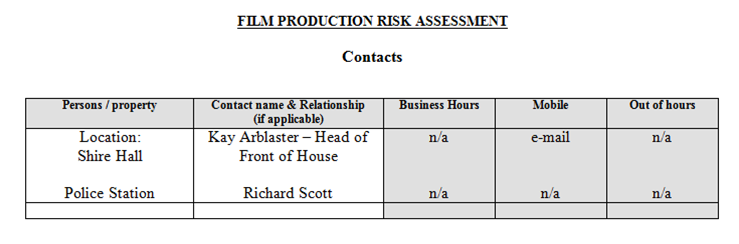
I completed a risk assessment form for all locations; Click to see larger view

I used this table to assess the serverity of the hazards;


I documented the main hazards for the locations;


I also documented contact names for each location in case of a problem;


Thursday, 24 March 2011

Finding Locations

Old Cell -

A local location - The Shire Hall has an old holding cell, with brick work and black bars that would be perfect to use.

I e-mailed them to enquire into filming for a day;


They replied expressing that there shouldn't be a problem with filming in the holding cell, however I would need to complete a risk assessment and go for a meeting to discuss electricity power, as this is limited within the holding cell.


Outside -

The outside locations were simple to find as local to my house there is a dirt track and brick bridge that would both work well with low key lighting.

I'm unable to use artificial lighting on the outside locations due to no access to electricity. I plan to use car headlights to light the shots, as this will link nicely with the theme of the song aswell as providing a decent amount of light.

Modern Cell -

I was able to arrange to film in a real police station as it is out of use for a short amount of time. I was able to arrange to film within a cell, that has the cream walls I was looking for, aswell as down a corridor of cell doors.

There is no issue in terms of electricity or space with this location.

Lyric Representation

The lyrics have a very strong meaning - The represent women standing together to speak out and fight against domestic violence.

The song is encouraging women to come forward, and stand strong with other women to fight against the increasing problem of domestic violence.

Quotes;

'I got these girls like a soldier trip and its going down..'
- Here she states she has a group of 'soldiers' ready to fight..

'if they get you, they get me..
- She is stating if one woman suffers, it affects all women as they stand together..

'i promise i'll stand and fight..
- She promises to other women she will stand and fight, and the lyrics can be taken as a warning against males that she will not stand for it..

'everybody quite when you did your dirt..'
- usually women stay quite after suffering an attack

'hell no we ain't done yet, got a lot to handle, we ain't took over the world yet..'
- it is an increasingly large issue that needs a lot to tackle

'we're an army, bet yet a navy..'- women are coming together to stand up and fight

'can't hurt us again when they come around here'

The repeated lyrics 'gangsta for life' represents the independence and strength of her individually and women as a whole.
Gangstas are stereotypically tough and strong, that fight hard, which is a perfect word to represent females standing up and speaking out against domestic violence.

Andrew Goodwin’s Music Video Theory/How to analyse a music video

Andrew Goodwin’s Music Video Theory


Key Points;

1 - Relationship between the lyrics and the visuals.
- Themes, mise-en-scene and events of the video match with lyrics of the song, to help to portray the message of the song.

2 - Relationship between the music and the visuals.

- The cuts and edits of the video are in sync with the rhythm and beat of the song matching cuts or effects to specific drum beats or notes.


3 - Music videos have genre characteristics

- Certain features are expected out of a video depending on the genre of the music, for example a girl bands/artists are expected to have dancers and close ups of the singers, whilst a Indi band are expected to have performance shots ofthe band and cut to a fast beat.


4 - Often due to the demands of the record label, artists videos will include many close ups of the artist and will often develop motifs that recur across multiple videos

- This allows the record label to promote a set image for the band, which will help target audiences empathise with the band.


5 - Emphasis on 'looking'

- The 'male gaze' is often used to attract a male audience. The male gaze is a focus on presenting things that appeal to men. This often means a voyeuristic view of, and an objectification, of women. The emphasis on looking also includes the artist looking directly into the camera helping the audience connect with the artist.


6 - Intertexual references.

- Music videos reference other forms of media, most commonly film, but can alos be television and other music videos.

How to analyse music videos;

Andrew Goodwin identifies 5 key aspects of music videos that we, the audience, should look out for;
- Thought beats – Where you ‘see’ in the sound
- Narrative and Performance
- The Star Image
- Relation of visuals to song
- Technical aspects of a music video

‘Thought Beats – ‘Seeing’ the sound
Step 1. To look at the music itself. We must take into account the structure of the song.


Step 2. The voice of the song. The artists voice is extremely unique and can form indentificatio or trademakrs that work well with the star image. Roland Barthes theory of the Grain of voice can be related to this. He sees the singing voice as an expressive instrument and therefore able to make associations of its own.


Step 3. Goodwin points out the artists mode of address. Songs can be seen as stories and the artist the storyteller, making the music video a two communication device – them telling us a story and we listening.


Narrative & Performance
Songs fail to give us the complete narrative.
We only tend to get a gist of the meaning of the song and then tend to make up our own idea of what is being told – An negociated view of a text.
Goodwin explains that music videos should ignore common narrative. It is important in their role of advertiseing.
Music videos should coherent repeatability. Narrative and performance work hand in hand its make it easier for the audience to watch over and over without loosing interest.
The artist acting as both narrator & participant helps to increase the authenticity however the lip sync and other mimed actions remains the heart of music videos. The audience need to believe this is real.


‘Star Image’
The star image is another vital aspect of music videos. Meta narrative which is a big story that describes the development of the star over time, it has an important part to play in the music video production process.


Relation of Visuals to the song
there are three ways in which music videos work to promote a song;


Technical Aspects
Technical aspects hold the music video together through use of camera work, movement, angle, mise-en-scene, editing, sound and special effects.
Speed, camera movement, editing, cutting and post production are all forms of use of camera.
Lighting and colour help set moods and emphasise key movements of the song for dramatic effect.
Mise-en-scene, the setting of music videos is vital, it needs to look authentic to attain professionalism.
Beats, music videos use cuts to go with the beat or rhythm making the video more entertaining.

Sunday, 13 March 2011

360 Music Video/Advertising

Artists are forever trying to think of new, fresh and unique ideas to keep their audiences interested.

Professor Green made an advertising partnership with Doritos.
Doritos would release special editions pack with a code on the back in order to view an interactive 360 music video from Professor Green, having benefits for both the artist and Doritos.
These were the first 360 interactive music videos created. The aim was that the audience could control what part of the music video they saw and each time you watched you saw something different, attracting them to revisit to continue new ways of watching and this would lead to the audience consuming more of the artist, therefore giving them more advertisement.

People who would not usually listen to Professor Green would still go just to view a new style of music video, and this would attract a new audience to the artist.

Link to 360 video: http://www.youtube.com/doritosuk

Other artists have made similar deals with Doritos, such as Rihanna.

Artists will often try other things to keep their audience interested or attract new ones, such as free downloads of a song for a certain amount of time.

This is common with new up and coming artists.
You are often able to download a song for free from an artist’s Myspace or website; this often attracts new audiences as they are able to ‘sample’ the music before committing to buying.
It takes more than music alone to be successful in the music industry today. Artists continuously have to either re-invent themselves, do unique advertising stunts or release merchandise such as clothing or jewellery.

Convergence/Media Consumption

Convergence

The idea that, because the progress of technology various different types of media (e.g. Computer, Television, Radio and Newspaper) are combining into a single media form.)
For example, television and computer technology are increasingly becoming the same. Websites have video on them and the Internet is an important part of the offer of most broadcasters. Computers and network technology has allowed television to offer "video on demand" services moving away from traditional "linear" or scheduled television.

Equally the Internet has become important for newspaper publishers. Newspaper has been a dying format for years - it is very difficult to compete with newer media that gives news up to the second when you present yesterday's news tomorrow on a sheet of paper. Consequently, a lot of newspapers have started to concentrate on producing Internet offerings. Increasingly as technology improves, these also offer video services - a move onto the turf of the traditional broadcasters.

The improvement in mobile technology has also allowed a lot of these services to be delivered to mobile devices as well bringing the operators of mobile networks into this convergence.


Convergence in terms of the Music Video

Convergence is growing ever more popular and essential for record labels and artists to distribute their music, including music videos.
Music videos were predominantly played on television, on music channels such as MTV, but over the years it has changed dramatically.
You can now download or stream music videos anywhere, in a variety of different ways.

Audiences now consume music videos from things such as:

Ipods – The development in the ipod now means you can download or stream music videos and consume them anywhere, from your back garden, to on the train or even whilst having a bath.

smart phones – The development in smart phones (mobile phones) has been incredible. You can now carry round a small device that works the same, and has all the functions of a computer. Within minutes you can download or stream a music video with great picture quality.

Ipads – Ipads are the newest gadgets to hit the market, and again are an easy travel computer.



iTunes
iTunes was introduced by Apple Inc. on January 9, 2001.
iTunes is a proprietary digital media player application, used for playing and organizing digital music and video files. The application is also an interface to manage the contents on Apple's iPod and iPhone lines, as well as the iPad.
iTunes can connect to the iTunes Store to purchase and download music, music videos, television shows, iPod Games, Audiobooks, Podcasts, movies and movie rentals (not available in all countries), and Ringtones (only available on iPhone and iPod Touch 4th Generation). It is also used to download Apps from the App Store for the iPhone, iPod Touch and iPad.
Within seconds you can download a whole album in the comfort of your own home, without having to take a trip to the local music store.


The Internet
Youtube.com
The internet has become the biggest and most popular way of consuming music videos.
Youtube.com is home to millions of videos, from music videos, to interviews and homemade videos people have uploaded.
You can search any music video in the world and the majority you will find in seconds.
Artist are becoming more and more well-known through youtube as people can quickly find new singles, music videos and interviews an artist has done.
Youtube has now taken over the search engine google.
You can type in an artist’s name or a name of a song and straight away will find a link to youtube very close to the top of the page.


It is a quick and simple way to consume music videos and slowly the internet will overtake music channels.

Youtube also helped spark many music careers for people such as Lily Allen & Justin Bieber. Justin Bieber would post videos of himself singing, got spotted by Usher and is now the most successful male artist today.
Youtube is not only for audiences to consume music videos, but for artists to promote themselves and their music.


Social Networking Sites
You can also easily share music and music videos over social networking sites such as Facebook and Myspace.
Facebook allows you to copy and paste a link from youtube and within a split second can share it with your whole friend list.


Friends can post videos to each other and comment, or you can simply post the link for everyone on your friends list to see. This spreads the word of new or current artists very quickly.

Distribution

In the 21st century, consumers spend less money on recorded music than they have in 1990s, in all formats.
The decline of CD's
Total revenues for CDs, vinyl, cassettes and digital downloads in the world dropped 25% from $38.6 billion in 1999 to $27.5 billion in 2008. Same revenues in the U.S. dropped from a high of $14.6 billion in 1999 to $10.4 billion in 2008. The Economist and The New York Times report that the downward trend is expected to continue for the foreseeable future.
Forrester Research predicts that by 2013, revenues in USA may reach as low as $9.2 billion. This dramatic decline in revenue has caused large-scale layoffs inside the industry, driven retailers (such as Tower Records) out of business and forced record companies, record producers, studios, recording engineers and musicians to seek new business models.


Illegal File Sharing

People can easily download music illegal through file sharing software such as Limewire. In the early years of the decade, the record industry took aggressive action against illegal file sharing. In 2001 it succeeded in shutting down Napster (the leading on-line source of digital music), and it has threatened thousands of individuals with legal action. This failed to slow the decline in revenue and proved a public-relations disaster. However, some academic studies have suggested that downloads did not cause the decline.

Legal digital downloads became widely available with the debut of the iTunes Store in 2003. The popularity of internet music distribution has increased and in 2009 more than a quarter of all recorded music industry revenues worldwide are now coming from digital channels.
However, as The Economist reports, "paid digital downloads grew rapidly, but did not begin to make up for the loss of revenue from CDs." The 2008 British Music Rights survey showed that 80% of people in Britain wanted a legal P2P service, however only half of the respondents thought that the music's creators should be paid. The survey was consistent with the results of earlier research conducted in the United States, upon which the Open Music Model was based.

The turmoil in the recorded music industry changed the twentieth-century balance between artists, record companies, promoters, retail music-stores and the consumer. As of 2010, big-box stores such as Wal-Mart and Best Buy retail more music than music-only stores, which have ceased to function as a player in the industry.


Live Performance & Merchandise
Recording artists now rely on live performance and merchandise for the majority of their income, which in turn has made them more dependent on music promoters like Live Nation (which dominates tour promotion and owns a large number of music venues.) In order to benefit from all of an artist's income streams, record companies increasingly rely on the "360 deal", a new business-relationship pioneered by Robbie Williams and EMI in 2007. At the other extreme, record companies can offer a simple manufacturing and distribution deal, which gives a higher percentage to the artist, but does not cover the expense of marketing and promotion. Many newer artists no longer see any kind of "record deal" as an integral part of their business plan at all.


Self-Distribution
Inexpensive recording hardware and software made it possible to record reasonable quality music in a bedroom and distribute it over the internet to a worldwide audience. This, in turn, caused problems for recording studios, record producers and audio engineers: the Los Angeles Times reports that as many as half of the recording facilities in that city have failed.
Changes in the music industry have given consumers access to a wider variety of music than ever before, at a price that gradually approaches zero. However, consumer spending on music-related software and hardware increased dramatically over the last decade, providing a valuable new income-stream for technology companies such as Apple Inc.